


BEST PRACTICES FOR SHOULDER INJURY RECOVERY
Home Exercise Equipment for Shoulder Rehab
Table of Contents
- Best Home Exercise Equipment for Shoulder Rehab
- Equipment Comparison Table
- Resistance Bands for Shoulder Strengthening
- Rotator Cuff Recovery Exercises with Dumbbells and Free Weights
- Pulley Systems and Wall-Mounted Wheels for Range of Motion
- Shoulder Rehab Duration: Timeline and Progression Tracking
- Best Practices for Shoulder Injury Recovery at Home
- Joint Support Supplements to Accelerate Recovery
- How to Integrate Home Equipment with Professional Physical Therapy
- Frequently Asked Questions
Last Updated: October 1, 2026
Best Home Exercise Equipment for Shoulder Rehab
Shoulder injuries sideline more lifters than any other joint problem. You miss workouts. You lose gains. Recovery stalls.
The global sports rehabilitation equipment market hit $4.79 billion in 2026 and is expected to expand at a CAGR of 9.3% through 2030 Yahoo Finance sports rehabilitation market report.
You need equipment that targets the rotator cuff, builds scapular stabilization, and restores range of motion without aggravating the injury. This guide breaks down the specific tools that work and how to use them.
Equipment Comparison Table
| Equipment Type | Price Range | Best For | Key Benefit |
|---|---|---|---|
| Resistance Bands | $14-$50 | Rotator cuff activation, early rehab | Low impact, adjustable resistance |
| Dumbbells (light) | $20-$100 | Progressive strengthening | Precise load control |
| Pulley Systems | $40-$200 | Range of motion, functional movement | Smooth resistance through arc |
| Wall-Mounted Wheels | $30-$150 | Passive and active range of motion | Gravity-assisted movement |
| Joint Support Supplements | $8.95-$119.99 | Cartilage health, inflammation control | Accelerates tissue recovery |
Resistance Bands for Shoulder Strengthening
Resistance bands are the foundation of shoulder rehab. They provide variable resistance that increases through the range of motion, exactly what your rotator cuff needs during early recovery.
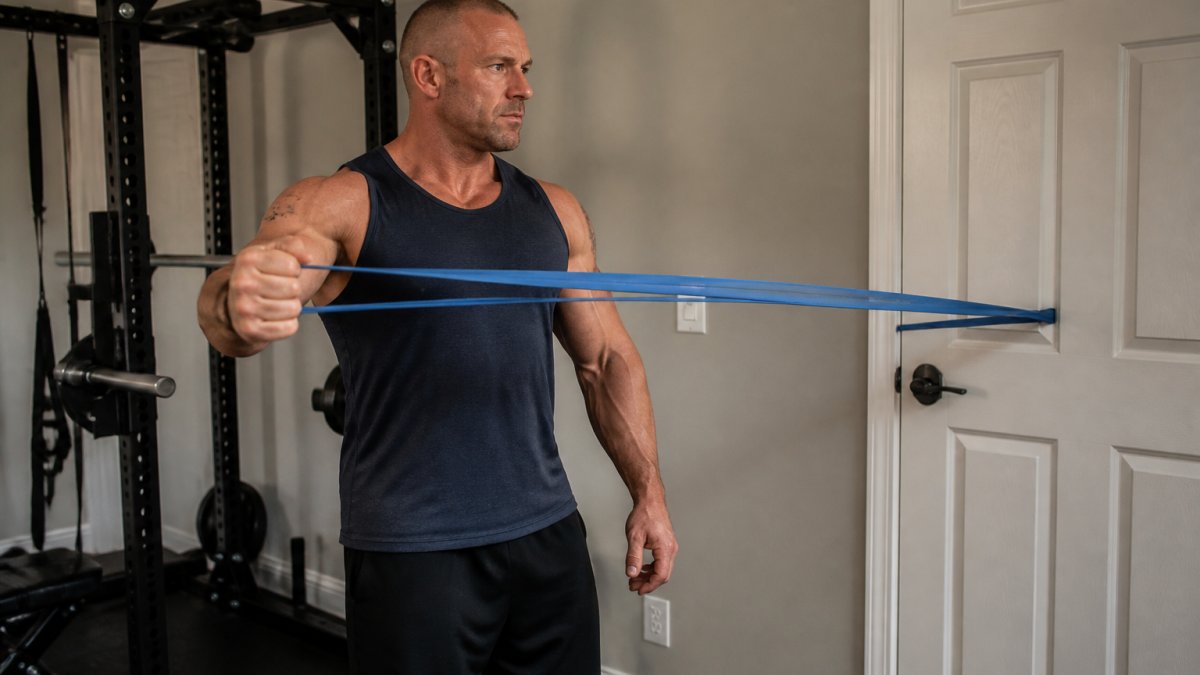
Start with light bands. Your goal is rotator cuff activation and endurance.
Bands are forgiving. Early in rehab, heavy dumbbells create too much joint compression. Bands let you work through pain-free ranges without that load.
Start with the lightest band. When 20 reps feel easy, move up. Most lifters spend 4-6 weeks on light bands before advancing to dumbbells.
Pro Tip Anchor bands to a door frame at shoulder height for rotations, or loop them around a sturdy object at different heights for varied angles. Consistency beats intensity in early-phase rehab.
Rotator Cuff Recovery Exercises with Dumbbells and Free Weights
Once you've spent time with bands, light dumbbells, 3 to 8 pounds, allow precise load control while building functional strength. Lateral raises, reverse pec deck movements, and Cuban presses target the deltoids and rotator cuff. Perform these with strict form, controlled tempo, and zero momentum. Three sets of 12-15 reps, two to three times per week.
Dumbbells force stabilization, building the scapular stability that prevents future injuries.
Progression: Week 1-2 use 3-pound dumbbells, Week 3-4 use 5 pounds, Week 5-6 use 8 pounds. If pain increases, drop back.
Watch Out Do not load the shoulder with heavy dumbbells before the rotator cuff is ready. Premature heavy loading causes re-injury and extends recovery by months. Conservative progression prevents setbacks.
Pulley Systems and Wall-Mounted Wheels for Range of Motion
Pulley systems and wall-mounted wheels restore range of motion. You control intensity by how much you push or pull.
Start with passive movement. Let gravity do the work. Your shoulder moves through the range without muscle effort.
A prospective, multicenter study of 148 cases found that home-based exercises, including range-of-motion work, are critical in treating shoulder stiffness MDPI home-based rehabilitation using sensors study. Controlled, pain-free movement through the full arc accelerates recovery.
Shoulder Rehab Duration: Timeline and Progression Tracking
Recovery timelines vary by injury type.
Rotator Cuff Strain or Minor Impingement (6-8 weeks)
Week 1-2: Use resistance bands.
Week 3-4: Add light dumbbells (3-5 pounds).
Week 5-6: Introduce lateral raises, reverse flyes, and light rows.
Partial Rotator Cuff Tear (12-16 weeks)
Small tears heal with aggressive rehab.
Week 1-3: Wear a sling for comfort.
Week 4-6: Begin light band work.
Post-Surgical Rotator Cuff Repair (16-24 weeks)
Follow your surgeon's PT protocols exactly.
Week 1-6: Immobilization in a sling.
Week 7-12: Begin light band work. Track range of motion.
Week 19-24: Gradually increase weight and complexity.
Frozen Shoulder (12-18 months)
Frozen shoulder is inflammation of the shoulder joint capsule.
Phase 3 (Months 10-18): Continue strengthening.
Universal Progression Tracking System
Track these metrics weekly:
-
Pain level (0-10 scale). Record pain at start, middle, and end of each session. Stay below 3/10 during rehab. Above 5/10 means you've exceeded capacity.
-
Range of motion. Measure overhead reach, external rotation, and internal rotation. Record weekly. ROM should improve 5-10% every two weeks in early phases, then 2-5% in later phases.
-
Strength (reps, sets, weight). Record exercise, weight, reps, and sets. When you complete all prescribed reps with zero pain, increase weight by 2-3 pounds.
-
Functional capacity. Can you reach overhead without pain? Can you throw? Can you perform your sport? Track these milestones.
-
Swelling and warmth. Swelling should decrease over time. If it increases after a session, you did too much.
The Progression Rule
Key Takeaway Progression tracking prevents two mistakes: advancing too fast (causing re-injury) and stalling too long (wasting recovery time). Write it down. Measure it weekly. Let the data guide your decisions. Use FREE TOOLS & FITNESS CALCULATORS to monitor your metrics and track progress systematically.
Best Practices for Shoulder Injury Recovery at Home
Recovery requires consistency, patience, and understanding your injury.
Understand Your Injury Type, It Changes Everything
Not all shoulder injuries are created equal. Know your diagnosis:
- Rotator cuff strain or tendinitis: Responds well to early movement and progressive loading. Start with bands immediately.
- Impingement syndrome: Requires scapular stabilization work before heavy loading. Avoid overhead pressing until pain-free.
- Rotator cuff tear (partial or full): Requires conservative progression and often surgery. Avoid heavy loading for 8-12 weeks minimum.
- Labral tear: Requires strict range-of-motion control. Avoid aggressive stretching.
- Frozen shoulder (adhesive capsulitis): Requires aggressive, consistent stretching and range-of-motion work.
- AC joint separation or arthritis: Avoid heavy pressing and pulling. Focus on scapular stability.
Ask your doctor or PT for the specific diagnosis and restrictions.
The Pain Scale Decision Rule
- 0-2/10 pain: Safe to work. This is your target range during rehab.
- 3-4/10 pain: Acceptable during exercise, but pain should resolve within 2 hours after.
- 5-6/10 pain: Stop. You've exceeded capacity.
- 7+/10 pain: Stop immediately. Contact your PT or doctor.
Warm Up Every Session
Five minutes of light band work before strength work:
- Arm circles: 10 forward, 10 backward.
- Band pull-aparts: 15 reps with a light band.
- External rotations with band: 15 reps, light resistance.
- Shoulder dislocates with a broomstick or PVC pipe: 10 reps.
Avoid Painful Ranges, But Don't Avoid Movement
Move through pain-free ranges to restore mobility. If overhead pressing causes pain at the top, perform the movement only to the point where it's pain-free.
Train the Opposite Side
Unilateral work prevents imbalance and compensation injuries. If your right shoulder is injured, perform single-arm dumbbell work on the left.
Address Scapular Stability First
Most shoulder problems stem from poor scapular control. Prioritize these movements:
- Band pull-aparts: 15-20 reps, three sets, three times per week.
- Face pulls: 15-20 reps with a light band or cable, three sets, three times per week.
- Wall slides: 10-15 reps, three sets, three times per week.
- Prone Y-T-W raises: 10 reps each position, three sets, twice per week.
Sleep and Nutrition Are Non-Negotiable
- Sleep: Seven to nine hours per night.
- Protein: 0.8 to 1 gram per pound of body weight daily.
- Anti-inflammatory foods: Fatty fish, berries, leafy greens, and olive oil.
- Hydration: Two to three liters of water daily.
Consistency Beats Intensity
Three sets of band pull-aparts, three times per week, for 12 weeks, beats one intense session per week. Set a schedule. Monday, Wednesday, Friday shoulder rehab.
Joint Support Supplements to Accelerate Recovery
Supplements don't replace rehab, but they accelerate it.
MTS Machine Motion combines cissus quadrangularis, curcumin, bromelain, and hyaluronic acid. Cissus relieves joint pain and promotes collagen synthesis. Curcumin combats inflammation by inhibiting cytokine production and down regulating COX-2 activity. Hyaluronic acid lubricates and cushions joints.

NOW Foods Glucosamine & Chondroitin with MSM targets cartilage health. Glucosamine supports cartilage repair.
Beverly Joint Care is a comprehensive blend of connective tissue builders and lubricators.
NOW Foods Tart Cherry 500 mg supports joint comfort through antioxidant protection.
NOW Solutions Joint & Muscle Cream provides topical support. Apply directly to the shoulder after workouts.
Start with NOW Foods Glucosamine & Chondroitin with MSM. Add MTS Machine Motion.
Best For Athletes recovering from shoulder injuries who want to accelerate tissue repair and reduce inflammation while maintaining training consistency.
How to Integrate Home Equipment with Professional Physical Therapy
Home rehab works best alongside professional guidance.
Session 1 (PT clinic): Assessment, manual therapy, initial exercise prescription.
Days 2-3 (home): Perform prescribed exercises. Track pain and range of motion.
Session 2 (PT clinic): Review home work. Assess progress. Adjust exercises.
Days 4-6 (home): Continue exercises. Progress based on PT guidance.
Session 3 (PT clinic): Reassess. Introduce new movements if ready.
Talk to your PT about what equipment you have at home.
Shoulder recovery is a process. Use resistance bands to activate the rotator cuff.
Frequently Asked Questions
What is the best equipment for shoulder rehab?
The best equipment depends on your injury stage and goals. Resistance bands are versatile for early-phase rehab and cost $14-$50. Dumbbells work well for intermediate strengthening. Joint support supplements like MTS Machine Motion ($39.99) and NOW Foods Glucosamine & Chondroitin ($16.95) accelerate recovery when combined with exercise.
How long does shoulder rehab typically take?
Shoulder rehab duration varies by injury type and severity. Progression tracking with your equipment helps identify when you're ready to advance intensity and prevents setbacks.
Can I do rotator cuff recovery exercises at home?
Yes. Rotator cuff recovery exercises work effectively at home with basic equipment. Resistance bands, light dumbbells (3-8 lbs), and bodyweight movements target the rotator cuff without requiring a clinic. Scapular stabilization exercises using bands are critical for preventing re-injury. Consistency matters more than equipment cost, perform exercises 5-6 days per week for best results.
What shoulder rehab equipment is most cost-effective?
Resistance bands are the most affordable entry point ($14-$30 for quality bands). Light dumbbells or filled water bottles cost under $20. Topical support like NOW Solutions Joint & Muscle Cream ($8.95) provides localized comfort. For comprehensive support, NOW Foods MSM ($15.95) and Tart Cherry ($18.95) offer proven joint recovery benefits. Effective home recovery starts under $100 with bands, light weights, and targeted supplements.
Should I use supplements alongside home exercise equipment?
Yes. Supplements amplify results when combined with exercise. MSM supports connective tissue formation and joint flexibility. Glucosamine and chondroitin maintain cartilage health during recovery. Tart cherry provides antioxidant support for post-exercise inflammation. MTS Machine Motion combines multiple ingredients, cissus, curcumin, and hyaluronic acid, for comprehensive joint support. Consult your physical therapist before starting any supplement regimen.
Leave a comment